Contents
mill docs
How it works
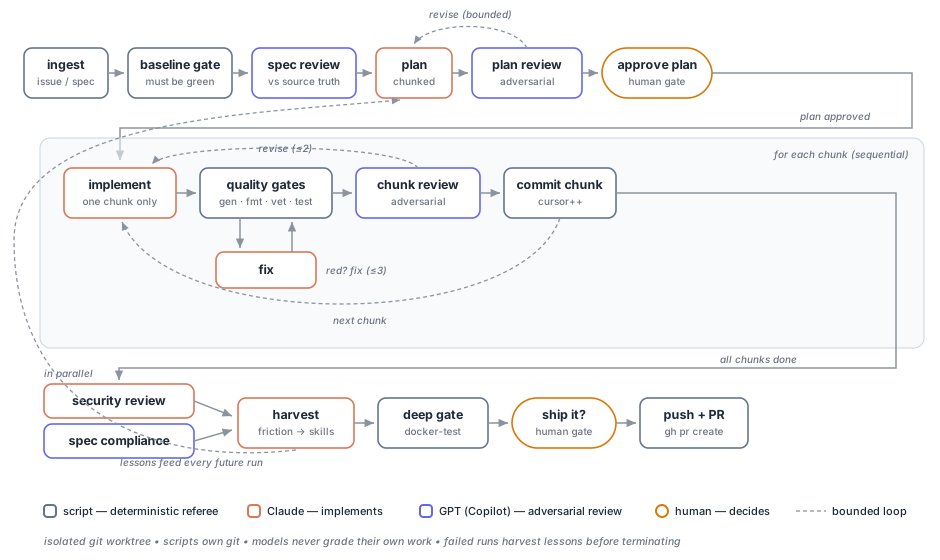
Ingest and baseline
A script fetches the spec (a GitHub issue via gh, or a file) and records
the base commit. The repository’s quality gates then run once before any
work starts — if the tree is already red, the run ends immediately, so every
later failure is attributable to the mill.
Spec review, before anything else
A run’s biggest risk is a spec that can’t be implemented as written. Before
a token is spent planning, a rival model validates the specification itself
against source truth: does it assume flags, files, or behaviors the code
doesn’t have? Does it contradict itself — especially universal invariants
(“every”, “always”, “never”) that current code doesn’t satisfy and that lack
a transition rule? Is it ambiguous in ways that change the work? Is it small
enough to converge (roughly a dozen chunks)? Findings escalate to a human
immediately; in --auto runs they abort. Fix the spec at its source and
rerun — that’s cheaper than discovering the same defects through six rounds
of plan review.
Plan, adversarially reviewed
claude reads the spec, the repository’s context docs, and every learned skill, then writes a chunked plan: ordered, independently implementable chunks with concrete acceptance criteria. A rival model walks the spec section by section trying to reject the plan — unmapped requirements, invariant violations, unreviewable chunks. Up to three revision rounds; a deadlock escalates to a human rather than dead-ending, because repeated rejection usually means the spec is ambiguous.
You approve the plan before implementation spends a token.
The chunk loop
For each chunk, in order: claude implements exactly one chunk; the repository’s gates run (a red gate loops to a fix step, at most three attempts); the staged diff goes to the rival reviewer against the chunk’s acceptance criteria (at most two revision rounds); a script commits and advances the cursor. Every loop is bounded and every exit is deterministic. Exhausting a bound ends the run as failed, with a resumable checkpoint — after a failure-harvest step distills what the failed run learned (see self-improvement).
Final reviews
Two reviews run in parallel over the whole branch: a security review against the repository’s declared invariants, and a spec-compliance audit that produces a requirement-by-requirement matrix — met, unmet, or deferred, each with file:line evidence. Any unmet requirement fails the run.
Harvest
The run’s friction — failed gates, objections, revision rounds — has been journaled throughout. A harvest step distills at most three durable lessons into the repository’s skills directory, where every future run (and every other agent, via the cross-agent links) reads them. A deterministic gate reverts anything harvest touches outside its allowlist. See self-improvement.
Rebase onto the moving base
A long run’s base branch moves under it — other contributors, other
automation. Right before the deep gate, the run rebases its branch onto the
latest base, so the gate validates the actual integrated result and the
eventual PR is current rather than stale. Conflicts are never auto-resolved:
the rebase aborts, the tree is left intact, and the run stops with
instructions for a human to resolve and re-run. (mill.sh also
fast-forwards the base to origin at launch, so runs start current too.)
Deep gate and ship
The heavyweight gate — typically the containerized test suite — runs last, covering everything including the harvest commit. Then the second human gate: read the final report, decide whether it ships. Publishing pushes the branch and opens a PR whose body carries the plan and the compliance matrix.